API 609 is the American Petroleum Institute standard titled Butterfly Valves: Double-flanged, Lug- and Wafer-type. It is the most widely referenced procurement standard for industrial butterfly valves in oil and gas, petrochemical, chemical, and general process piping across global projects. The standard covers design, materials, pressure-temperature ratings, face-to-face dimensions, inspection, and testing for butterfly valves from NPS 2 through NPS 96 (DN50 through DN2400), with pressure classes up to Class 600.
API 609 divides butterfly valves into two fundamentally different families — Category A (concentric, soft-seated) and Category B (double-offset, high-performance) — and this single distinction drives almost every downstream engineering decision, from seat material and leakage rate to actuator torque and fire-safety requirements.
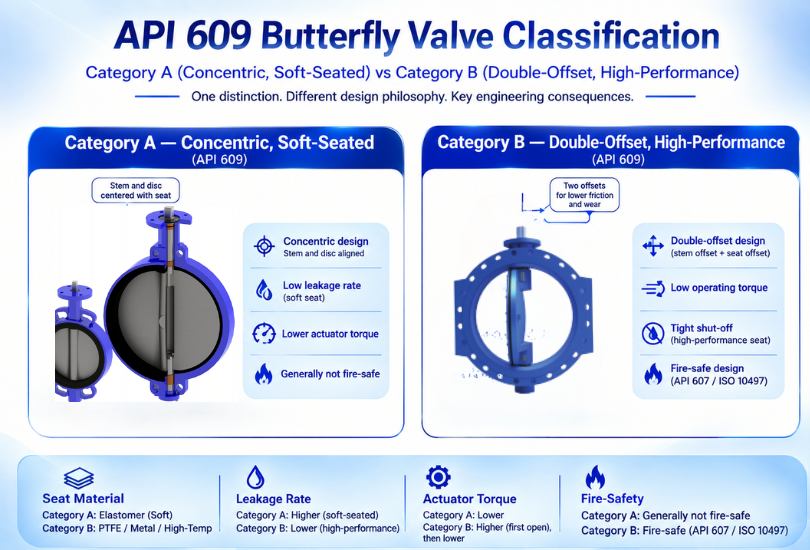
The Category A / Category B split is the first thing any specification engineer must resolve. The two categories use different sealing physics, different materials, and different failure characteristics.
In a Category A valve, the shaft passes directly through the center of the disc and the center of the seat. The disc edge remains in continuous contact with a rubber or elastomer seat for most of the rotation. Sealing is achieved by compression of the elastomer between the disc edge and the body — a simple, robust, and low-cost design.
In a Category B valve, the shaft is offset twice: first behind the sealing plane, and second to one side of the pipe centerline. This cam-like geometry lets the disc lift off the seat after only a few degrees of opening, eliminating the continuous rubbing that characterizes Category A. Category B valves can therefore use metal seats, PTFE seats, or high-performance laminated seals — and achieve much higher pressure and temperature ratings.
Laux Valve manufactures both categories: lug and wafer concentric soft-seated valves to Category A, and a double offset butterfly valve with CF8M disc to Category B.
| Item | Category A (Concentric) | Category B (Double Offset) |
|---|---|---|
| Shaft offset | Zero — shaft through disc center | Double — shaft behind sealing plane and off pipe centerline |
| Seat type | Elastomer (EPDM, NBR, FKM) | PTFE, RTFE, metal, laminated |
| Pressure classes | Class 125 / 150 | Class 150 / 300 / 600 |
| Max temperature | ~120°C (elastomer limit) | Up to +538°C (metal seated) |
| Disc-seat contact | Continuous during rotation | Only at final 2-3° of closing |
| Operating torque | Higher (elastomer stiction) | Lower (cam action) |
| Fire-safe capable (API 607) | No | Yes |
| Typical cost | Lower | 2-4× higher |
API 609 covers three body styles. The choice affects installation, maintenance access, and end-of-line capability. For a full side-by-side comparison, read our guide on wafer vs lug vs double flange butterfly valves.
The body has no lugs or flanges; it is clamped between two pipe flanges by long through-bolts. The lowest-cost, lightest option, but cannot be used for end-of-line service because the valve body has no independent pressure retention.
Threaded lugs cast into the body accept bolts from each pipe flange independently. A lug valve can be used for dead-end service at full rated pressure, and the downstream pipe can be removed while the upstream side remains under pressure. See our lug butterfly valve collection.
Integral flanges on both ends, bolted flange-to-flange with the mating pipe flanges. The heaviest and most rigid design, self-centering, rated for full bidirectional pressure and end-of-line service at all sizes up to NPS 96. Laux Valve builds these for waterworks applications such as the AWWA C504 rubber-seated butterfly valve.
API 609 valves are rated by pressure class, using the same class system as ASME B16.5 flanges. The pressure class determines the flange drilling, body wall thickness, and maximum allowable working pressure at a given temperature.
| Pressure Class | Category | Typical Body Material | Max CWP at 38°C (100°F) | Typical Size Range |
|---|---|---|---|---|
| Class 125 | A | Cast iron (ASTM A126) | 200 psi (13.8 bar) | NPS 2-48 |
| Class 150 | A and B | Ductile iron, WCB, CF8M | 285 psi (19.6 bar) | NPS 2-96 |
| Class 300 | B | WCB, CF8M, duplex | 740 psi (51 bar) | NPS 2-60 |
| Class 600 | B | WCB, CF8M, duplex | 1,480 psi (102 bar) | NPS 2-36 |
Temperature limits are controlled by the seat and body materials, not by the pressure class itself. A Category A EPDM-seated valve is limited to about 120°C even though its Class 150 body could structurally withstand more. A Category B metal-seated valve in a WCB body can reach +427°C with appropriate trim, and CF8M bodies extend that further. Always read the pressure-temperature rating table supplied by the manufacturer for the specific body-seat combination.
API 609 does not invent its own face-to-face dimensions for double-flanged valves — it references ASME B16.10 for flanged butterfly valve lengths. For wafer and lug valves, the face-to-face is the manufacturer's short pattern, typically aligned with the industry-standard lengths also used by MSS SP-67 and EN 558 Series 20.
| Valve Type | Face-to-Face Reference | DN600 (24") Typical Length | Notes |
|---|---|---|---|
| Wafer (short pattern) | Manufacturer / MSS SP-67 / EN 558 Series 20 | ~152 mm | Compact; fits between existing flanges |
| Lug (short pattern) | Manufacturer / MSS SP-67 / EN 558 Series 20 | ~152 mm | Same short length as wafer but with threaded lugs |
| Double-flanged (long pattern) | ASME B16.10 / EN 558 Series 13 | ~267 mm | Self-centering; full raised-face flanges |
For replacement applications, always measure the installed face-to-face before ordering. A wafer valve cannot be dropped into a double-flanged spool without adapters, and a double-flanged valve will not fit the short gap between existing flanges.
API 609 mandates several design features that separate a standards-compliant valve from an under-engineered lookalike.
The stem must be retained so that line pressure cannot eject it from the body. In a compliant valve, the stem has a machined shoulder or collar that locks against the body or a retaining ring at the inner end. Even if the external stem retainer, gland, or actuator is removed, the stem cannot blow out under pressure. This is the single most important safety feature in a butterfly valve, and it is also required by EN 593 and AWWA C504. For a deeper look at stem metallurgy and design, read our butterfly valve stem materials guide.
The seat must be mechanically retained or bonded so it cannot extrude, creep, or blow out under full differential pressure. In Category A valves this means a vulcanized or mechanically clamped elastomer seat. In Category B valves, the PTFE or metal seat is retained in a machined groove or by a bolted seat ring.
Torque transfer between the stem and disc must use a machined drive — square, double-D, keyed, or spline — never a weld or a pinned joint alone. The drive profile must be machined into the full-strength section of the stem.
Although API 609 does not itself define the actuator interface, modern butterfly valves use the ISO 5211 mounting standard for the top flange, so any pneumatic, electric, or hydraulic actuator mounts directly without adapters.
Every API 609 valve must be hydrostatically shell-tested and seat-tested before shipment. The test procedure references API 598 for valve inspection and testing practice.
| Test | Test Pressure | Duration | Acceptance Criterion |
|---|---|---|---|
| Shell (body) hydrostatic test | 1.5 × rated CWP | Per API 598 (min. 15 s to 5 min by size) | No visible leakage through body, flanges, or shaft seal |
| Seat leakage test (Category A) | 1.1 × rated CWP | Per API 598 | Zero visible leakage (bubble-tight) for elastomer seats |
| Seat leakage test (Category B) | 1.1 × rated CWP | Per API 598 | Per specified leakage class — soft-seated typically zero leakage; metal-seated allows a defined rate |
| Fire test (optional) | Per API 607 / ISO 10497 | Full burn + cool-down cycle | Leakage within fire-test limits after burn and after thermal shock |
For Category B valves specified for fire-safe service, the fire test to API 607 is a separate, destructive test that verifies the valve retains a minimum sealing function during and after a full-scale fire exposure. Fire-safe certification applies only to the tested design, size, and materials — never assume a valve is fire-safe because it "looks similar" to a tested one.
API 609 requires the following markings on every valve body and nameplate:
Documentation should include a material test certificate (EN 10204 3.1 or equivalent), hydrostatic test report, and, for fire-safe valves, the API 607 fire test certificate. Laux Valve ships every API 609 valve with MTC and test reports; contact us at Laux Valve engineering support to request a documentation sample.
API 609 is one of several butterfly valve standards, and understanding the overlaps prevents mis-specification.
| Standard | Origin | Scope | Key Difference from API 609 |
|---|---|---|---|
| API 609 | USA (petroleum) | Butterfly valves for general industrial and hydrocarbon service, Category A and B | Reference standard; broad pressure range to Class 600 |
| EN 593 | Europe | Industrial valves — metallic butterfly valves | European equivalent; uses PN ratings (PN10/16/25/40) instead of Class ratings; CE marking under PED |
| AWWA C504 | USA (waterworks) | Rubber-seated butterfly valves for water supply | Water-specific; ductile iron body, EPDM/NBR seat, fusion-bonded epoxy; see our AWWA C504 product page |
| ISO 10631 | International | Metallic butterfly valves for general purpose | International harmonized standard; dimensional and pressure data align with ISO/EN practice |
| MSS SP-67 | USA (manufacturers) | Butterfly valves | Manufacturer association standard; frequently cross-referenced for wafer/lug face-to-face dimensions; less strict on testing than API 609 |
In practice, many butterfly valves are dual-marked API 609 and EN 593, or API 609 and AWWA C504, because the dimensional requirements overlap for common sizes. When a project specification calls for one standard, do not substitute a valve certified only to another without confirming face-to-face, drilling, and testing requirements.
| Industry | Typical Category | Media | Typical Size and Class |
|---|---|---|---|
| Water and wastewater treatment | A | Water, sewage, sludge | NPS 2-96, Class 125/150 |
| HVAC and building services | A | Chilled/hot water, glycol | NPS 2-24, Class 125/150 |
| Oil and gas production | B | Crude oil, produced water, gas | NPS 2-48, Class 150/300/600 |
| Refining and petrochemical | B | Hydrocarbons, steam, chemicals | NPS 2-36, Class 150/300/600, often fire-safe |
| Chemical processing | B (or PTFE-lined A) | Acids, solvents, aggressive media | NPS 2-24, Class 150/300; see PTFE lined butterfly valves |
| Marine and offshore | B | Seawater, ballast, fuel | NPS 2-48, Class 150/300, duplex/bronze bodies |
| Power generation | A and B | Cooling water, condensate | NPS 6-96, Class 125/150/300 |
Use these lines on any RFQ or data sheet to close the specification:
Category A is a concentric butterfly valve with the shaft through the disc center and an elastomer (rubber) seat, limited to Class 125/150 and about 120°C. Category B is a double-offset valve with the shaft behind the sealing plane, available with PTFE or metal seats, rated to Class 300/600 and temperatures up to +538°C. Category B is the high-performance, fire-safe-capable design.
No. API 609 is the design and construction standard for butterfly valves. API 598 is the valve inspection and testing standard that defines how shell and seat tests are performed. API 609 references API 598 for testing procedure, but the two standards serve different purposes.
No. A wafer valve has no independent pressure retention — it is clamped between two flanges. If the downstream pipe is removed while the valve is closed under pressure, the valve body can eject. Use a lug butterfly valve or double-flanged valve for dead-end service. This is the same rule regardless of which standard the valve is built to.
No. Fire-safe design is an optional requirement invoked by the purchaser. When fire safety is required, the valve must be a Category B double-offset design tested to API 607. Category A elastomer-seated valves cannot be fire-safe because the rubber seat is destroyed by fire.
API 609 covers NPS 2 through NPS 96 (DN50 through DN2400). In practice, Category A valves above NPS 48 are rare and usually specified to AWWA C504 instead. Category B double-offset valves above NPS 60 are also rare due to the torque and weight involved.
Not automatically. EN 593 uses PN pressure ratings and EN flange dimensions, while API 609 uses Class ratings and ASME flange dimensions. A dual-marked valve (API 609 + EN 593) is acceptable in most jurisdictions, but a valve certified only to EN 593 should not be substituted without confirming face-to-face, flange drilling, body material, and testing requirements against the API 609 specification.
At minimum: material test certificates (EN 10204 3.1), hydrostatic shell test report, seat test report, and the API 609 compliance declaration. For fire-safe valves, add the API 607 fire test certificate. Laux Valve provides this full documentation package with every industrial butterfly valve shipment; contact Laux Valve to request a sample package for review.
The choice is driven by media chemistry and temperature. EPDM for water and dilute acids/alkalis; NBR for oils, fuels, and oily wastewater; FKM for aggressive chemicals and higher temperature. Our EPDM vs NBR guide gives the full selection logic with a media resistance table.
API 609 is an industrial standard spanning water to hydrocarbon service, with Category A and B designs and Class ratings. AWWA C504 is specifically for municipal waterworks rubber-seated butterfly valves, mandating ductile iron bodies, EPDM/NBR seats, fusion-bonded epoxy coatings, and its own face-to-face and testing requirements. A waterworks valve should be specified to AWWA C504; a process or refinery valve should be specified to API 609. Laux Valve builds both — see the AWWA C504 butterfly valve for water service and the double offset Category B valve for industrial service.


